Every Nigerian landlord eventually hits the same wall. You start with one flat in Lekki or a duplex in Guzape, tracking rent dates on your phone. Then you add another. Then a tenant calls about a leaking tank at 11pm, another swears they paid last month, and your "system" (a mix of WhatsApp, bank alerts, and a printed receipt book) quietly starts to leak money. This is when most landlords start looking for property management software in Nigeria.
Why landlords are moving on from spreadsheets
Spreadsheets are fine when you have one or two units. They stop being fine the moment you have three or more, or the moment you bring in a manager. A few things start to go wrong at the same time:
- You forget which tenant paid which month, especially when one pays partly in cash and partly by transfer.
- You stop sending receipts on time, and tenants stop trusting your records.
- Maintenance requests fall through the cracks, and small issues become expensive ones.
- Rent renewals sneak up on you, and you discover three weeks later that a tenant has been living rent-free.
The fix is not to work harder. The fix is to put the boring stuff on autopilot so you can spend your time on the parts that actually grow your portfolio.
What property management software actually does
At its core, a good platform does five jobs for you:
- Rent collection. It sends reminders, accepts payments online, and reconciles them automatically against each tenant.
- Tenant management. One profile per tenant with their lease, contact details, ID, payment history, and notes.
- Maintenance tracking. Tenants log issues, you assign vendors, the system keeps a record so nothing is forgotten.
- Reporting. Real numbers on income, arrears, occupancy, and yield, not vibes.
- Documents. Tenancy agreements, receipts, and inspection reports stored against the right unit, where you can find them at 6am or at 11pm.
Xtate, our own property management software built for Nigerian landlords, covers all five out of the box. But whether you choose Xtate or someone else, those five capabilities are the floor, not the ceiling.
Must-have features for the Nigerian market
International tools often miss the realities of operating here. Before you sign up for anything, make sure it handles the following:
Naira-first rent collection
Your software should accept rent in NGN through familiar rails: Paystack, Flutterwave, direct bank transfer with auto-reconciliation, and ideally USSD for tenants who do not bank online. If you have to manually match a transfer to a tenant every month, the software is not earning its fee.
NIN and BVN verification
NIN (National Identification Number) is now required to open most accounts and to formally identify a person in Nigeria. BVN (Bank Verification Number) ties a person to their bank records. Any serious property management software should let you verify a prospective tenant's NIN, and ideally BVN, before you sign a lease. If you want to dive deeper, read our guide on tenant verification in Nigeria.
WhatsApp and SMS notifications
Email is fine for receipts, but the average Nigerian tenant lives on WhatsApp. Rent reminders, payment confirmations, and maintenance updates should go where your tenants will actually see them.
Offline-friendly behaviour
Power and data can be patchy, especially across smaller cities. Look for a tool that lets your manager log activity offline and sync later, or that at least loads quickly on a slow 3G connection.
Multi-property dashboards
If you own a four-flat in Enugu and a duplex in Abuja, you need a single dashboard that shows total income, occupancy, and arrears across both, not two separate spreadsheets you have to add up by hand.
The hidden costs of poor property management
Most landlords think of property management as a fixed cost. It is not. Bad management is a tax on your yield, and it usually shows up as:
"I had a tenant who 'forgot' two months of rent. By the time I sat down to chase, it was four months. We settled for three. That single oversight cost me more than five years of software fees would have."
Beyond direct losses, there is reputation damage. Tenants talk. If your building has a name for late receipts, missed repairs, or arguments about deposits, your next vacancy will take longer to fill, and that empty month is pure loss.
Five questions to ask any vendor
Before you commit to any platform, get clear answers to these:
- How do you handle rent collection in NGN, and what is your total fee per transaction? Watch out for stacked fees: software fee plus payment processor fee.
- Where is my tenant data stored, and are you NDPR compliant? NDPR is the Nigeria Data Protection Regulation. Your tenants' IDs and bank details are sensitive.
- What happens to my data if I leave? You should be able to export everything in a standard format.
- How do tenants pay, and what happens if a payment fails? Look for automated retries and clear failure notifications.
- What support is available, and in what time zone? A vendor in another continent with email-only support is not your friend at 9pm on a Sunday.
A quick look at Xtate
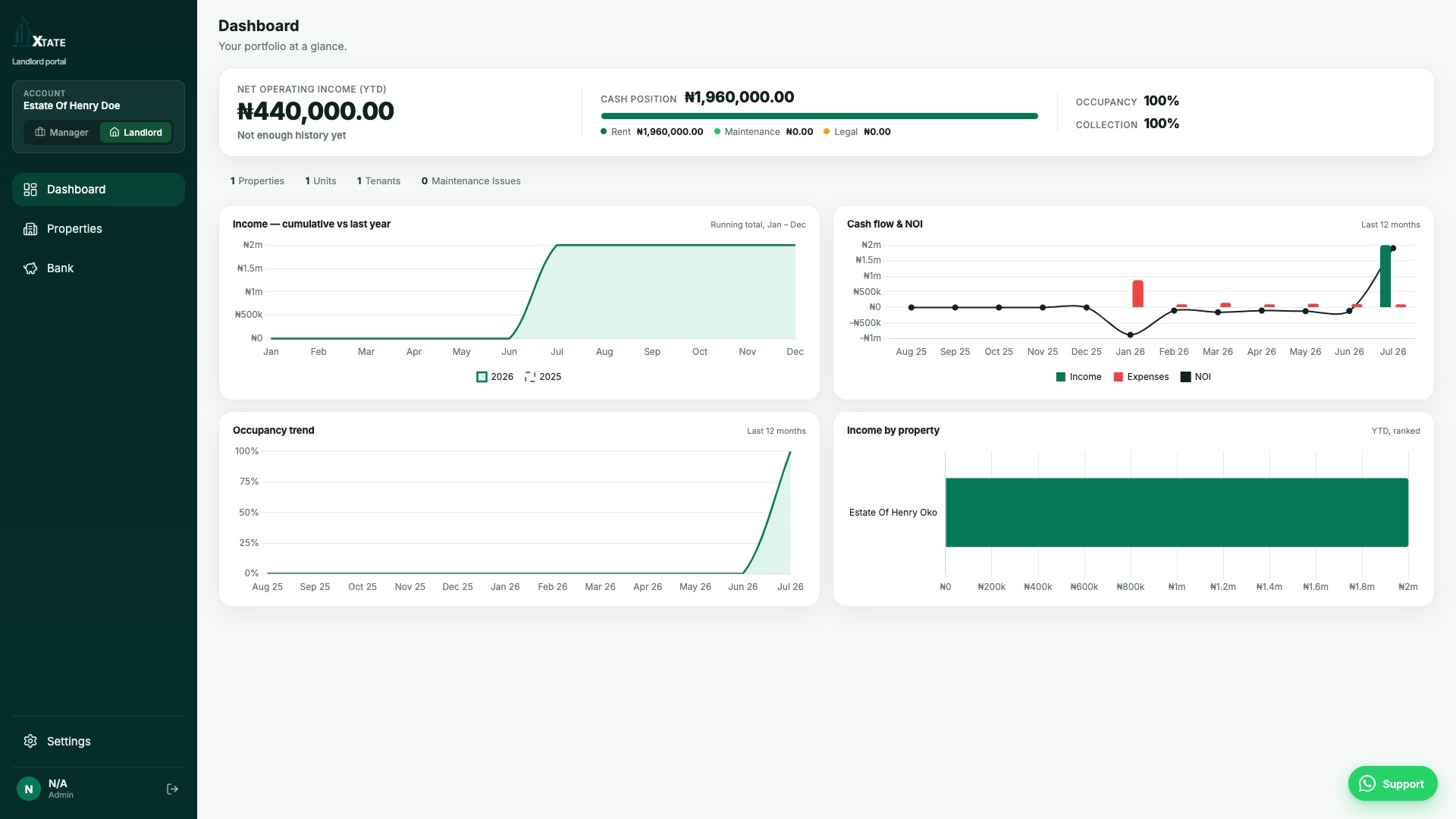
We built Xtate because the existing options either ignored Nigeria or treated it as an afterthought. Xtate handles rent collection in NGN via Paystack and direct transfer, sends WhatsApp reminders, runs NIN-based tenant checks, tracks maintenance against each unit, and gives you a clean dashboard across every property you own. It is designed for landlords with two to fifty units, the segment most international tools ignore. You can see how it works on the Xtate product page, and we have a deeper comparison piece on software versus spreadsheets if you are still weighing it up.
How to get started
You do not need to digitise everything in one weekend. Start with one property. Move that tenant's lease, ID, and payment history into the platform, set up rent reminders, and run one full cycle. Once you see the receipts arrive automatically and the arrears report tell you the truth, you will move the rest of your portfolio across willingly.
Related reading
- How to Collect Rent Online in Nigeria: 5 Methods Compared
- Tenant Verification in Nigeria: NIN, BVN, and What Actually Works
Whichever route you take, the goal is the same: stop running your portfolio out of your head, and start running it out of a system. Your future self (and your bank balance) will thank you.